
The Sniff Test
Learnings From Startup Week 2. A Nonprofit Life Hack. And A Possible Legal Dustup With Penguin Books.

“There are no ordinary people. You have never talked to a mere mortal.” CS Lewis
Hello Extraordinary Person! Happy Saturday! Thanks for stopping by my Substack.
To learn why this Substack exists, why it’s called Cairns, and what I talk about, visit my About Page.
Subscribe for free. New posts delivered to your inbox every Saturday!

Recapping Startup Week 2 - The Sniff Test
When you’re first pulling together your business concept for a startup, you’re exploring whether there is a market for your idea, thinking about the revenue projections, who your actual customers will be, fine-tuning what the problem is you are trying to solve, risk factors, potential partners, competitors, your unique value proposition, and a million other things.
Will this thing be financially viable? Will anybody buy it? Will it provide anything of value to the world?
Typically, you pull all of this together into an initial pitch deck (usually a PowerPoint-type presentation). You use this to begin getting high-level feedback from knowledgeable sources THAT WILL HONESTLY TELL YOU WHAT THEY THINK about the overall business concept. Think of these folks as bloodhounds.
At this point, they (nor you) fully understand the true viability of the business. That’s OK. The idea is to simply do a quick, commonsense check to see if the thing seems reasonable, credible, or marketable before taking it further. It’s called a sniff test.
Does the thing stink on the face of it? Would a reasonable person buy this? Does it seem plausible - something to pursue further?
Assuming you’ve found a couple of good bloodhounds, you’ll know whether to go further down this trail or head back home and start a different hunt.
This week, I passed the sniff test with a couple of evaluators. That’s my big accomplishment for the week.

Last week, I mentioned that I may be setting up the first phase of this business as a nonprofit (or maybe not - to be determined). Here’s a life hack if you’re thinking about setting up a nonprofit.
A Nonprofit Life Hack - How To Legally Operate As A Nonprofit By NOT Setting Up A Nonprofit
Setting up a nonprofit or business is a pain, no matter what form you go with. I know of folks who have spent hours working on their nonprofit submittals, waiting months to get approved by the IRS (or not), and then getting all their backend donor and administrative services set up.
This is NOT where you need to be spending your time in the early days of your nonprofit. You need to be schmoozing donors. Writing grants. Organizing events. Serving your constituencies. Etc.
So here’s a hack. Don’t set up your nonprofit yet. Do this instead.
Do a fiscal sponsorship. The National Council Of Nonprofits summarizes the FS this way:
Fiscal sponsorship is often used by newly formed nonprofits that need to raise money during the start-up phase, before they are recognized as tax-exempt by the IRS. Using a fiscal sponsor enables a program or organization that does not itself qualify as tax-exempt to attract funding for its operations that will -- through the fiscal sponsor - be tax-deductible to donors. Therefore fiscal sponsor arrangements benefit organizations or programs that are not tax-exempt by providing a flow-through pathway for revenue that the organization may not otherwise be in a position to receive.
The main advantages of a fiscal sponsorship are these:
Fiscal sponsorship might be chosen by a newly formed nonprofit that seeks to test-drive its ideas to determine whether there is a market or a desire among the public to fund the end product.
Some organizations/programs remain in a fiscal sponsorship relationship for a long time, deciding that their mission can be achieved in that structure without creating a new entity.
From past experience, I plan to use Christian Ministry Alliance for my fiscal sponsorship (if I initially to the nonprofit route). Here is their fee structure:
Administrative fee is 5% of monthly processed revenue.
We do not charge on held fund balances - this means your fund balance will never be charged an assessment for custodial purposes.
No application fee, renewal fee, or minimum balance requirement
No geographic limitations - Projects from 24 countries around the world have participated in our program
What does this get you?
Payment processing. Allows your nonprofit project to collect tax-deductible contributions under the Alliance’s 501(c)(3) status and make payments, reimbursements, and grants as necessary.
Compliance. CMA manages tax and audit compliance. CMA sends receipts to donors and 1099s to vendors; and we include your financial information in our financials and IRS Form 990.
Every situation is different, but if you are a start-up nonprofit, I’d take a good look at doing this.
But If You Really Just MUST Form Your Nonprofit, Do This
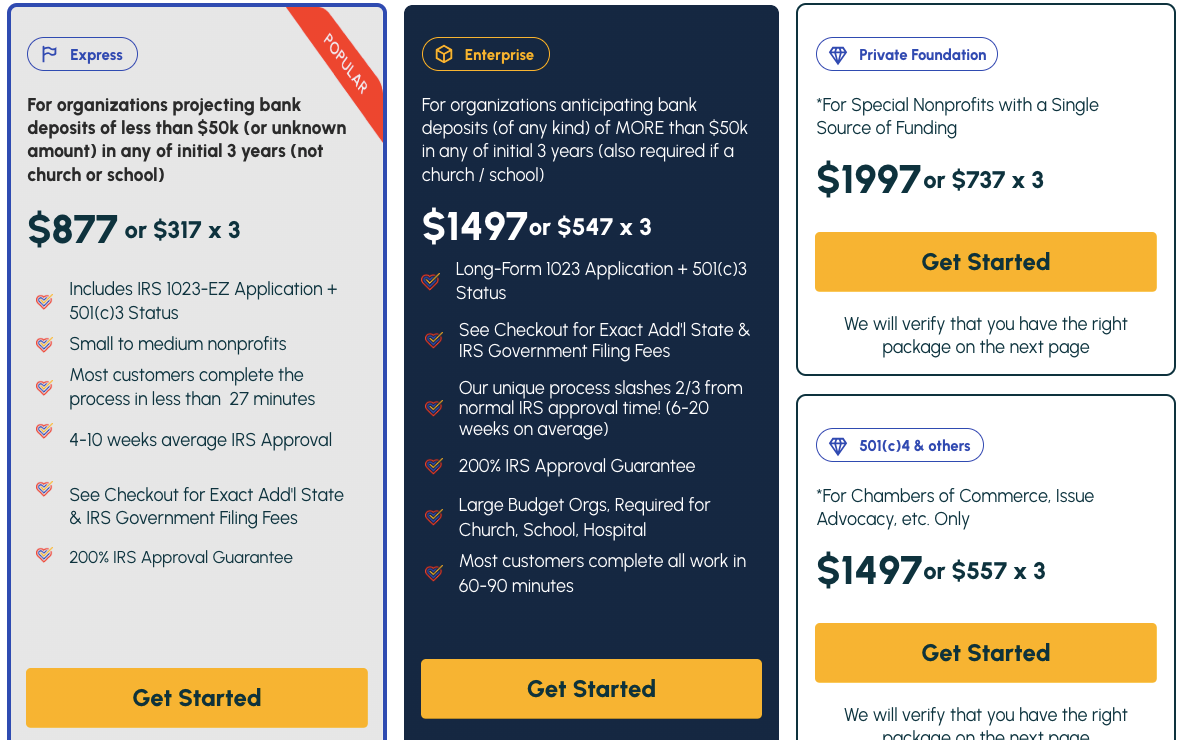
I have referred folks to Christian LeFer at Instant Nonprofit for years. They have set up thousands of nonprofits in all nonprofit designations under the IRS code. Their current fee structure is below.
I checked with a friend who used them recently. Here’s what he texted me:
We were approved the first time around with no resubmissions. 30 minutes of work & had our approval in 9 weeks.
Brad J
Do this to stay focused on your mission.
You’re welcome!
Strengthening My Resolve
Offering all this up, while echoing the Psalmist’s prayer:
They still bear fruit in old age;
they are ever full of sap and green,
to declare that the Lord is upright;
he is my rock, and there is no unrighteousness in him.
Psalm 92:14-15 (ESV)
It’s a dangerous business, Frodo, going out your door. You step onto the road, and if you don’t keep your feet, there’s no knowing where you might be swept off to.” - JRRT
What I’m Reading (Or Not Reading) This Week
For the past couple of weeks, I’ve been reading A Perfect Spy by John LeCarre. Spy novels are kind of my guilty pleasure. I sneak them into my reading stack when I have the time.
The Penguin Books edition of the book is 603 pages long. So I’m cruising along at page 526, heading toward the big, gripping, climactic ending. Is our protagonist actually a double-agent? Has he been compromised? Why has he suddenly gone missing? These questions demand answers.
So I turn the page. But it’s NOT page 527. It’s page 543! Where I come from, 543 does not follow page 526. SIXTEEN PAGES OF THE BOOK ARE MISSING!!! ARE YOU KIDDING ME??
When pages go missing - in a spy novel of all things - something’s afoot. Am I now caught up in some international conspiracy? Should I be watching for shady characters around every corner?
I am considering legal action for compensatory damages caused by Penguin Books.
However, until the missing pages can be recovered, the library is attempting to get me a copy with all the pages.

A Quick Shout Out
Again, thanks to Fika Coffee House in Parker, CO, for becoming the unofficial Cairns hangout. Fika is a Swedish verb which, loosely translated, means “to meet over coffee.” Been doing the majority of my writing/posts there. Shouting out to both locations - thanks for the space and lattes.
Be Swell Extraordinary People!!
Thanks for reading Cairns! Subscribe for free to automatically receive new posts in your inbox.